



Basil Odilim
Some years ago, in the course of litigation, a Senior Advocate of Nigeria once referred to me in his client’s defense statement as a “gold digger.” It looked casual.
Not long after, we met unexpectedly. He greeted me warmly, almost cheerfully. I approached him with equal courtesy and reminded him of his choice of words. “If I am truly a gold digger,” I said, “then I must at least be shown the gold mines.”
He laughed it off. “Ah, leave that—it is just our way of talking.”
But I did not see it that way. Because those words did not vanish with the moment. They entered the court record. And once recorded, language acquires a permanence that outlives intention, humour, or context.
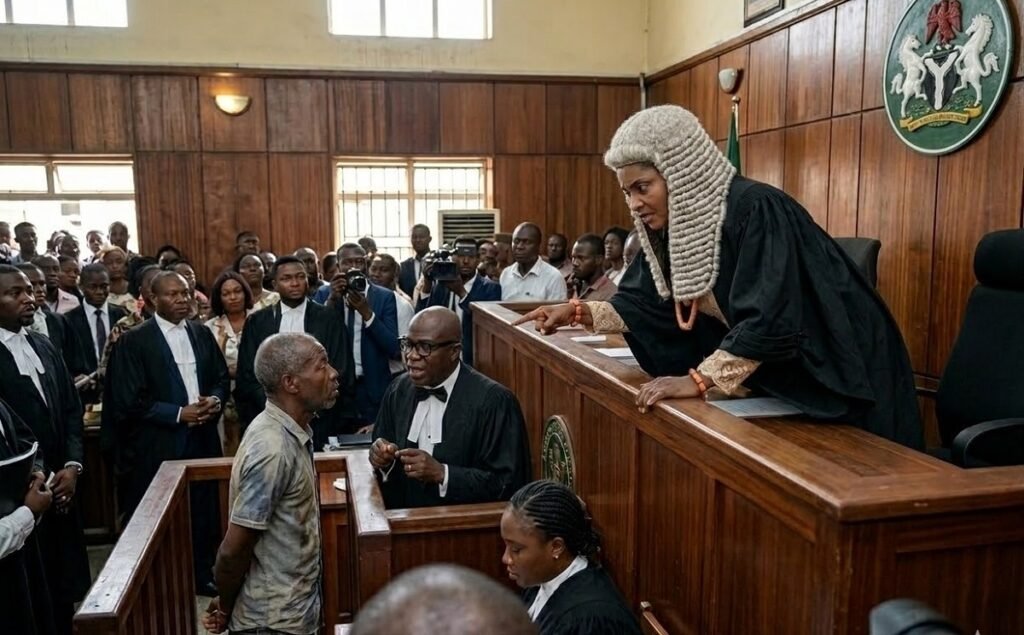
It is this quiet permanence of words that returned to me as I revisited the recent interlocutory ruling delivered by Hon. Justice Maryanne Anenih. I was not taken aback by the outcome. I had long anticipated that the issues raised would ultimately find their resolution on appeal.
What unsettled me—what lingered uneasily—was not the decision itself, but the language through which it was expressed.
A courtroom is not an ordinary arena. It draws its authority not from force, but from restraint; not from volume, but from measured clarity. It is a space that symbolizes reflection, discipline, and moral guidance. Within that space, words are not merely spoken—they are weighed.
The legal profession, often described as the noblest of callings, imposes a rare burden on its actors. Lawyers and judges are not merely participants in disputes; they are custodians of language, tone, and ultimately, the dignity of justice itself. When that discipline falters, even momentarily, the consequences extend beyond the immediate case.
It is in this light that one recalls the enduring caution of Lord Atkin, who warned that “justice is not a cloistered virtue.” Yet even in its openness, justice is not a license for unrestrained expression. Judicial authority must persuade, not provoke.
Similarly, Benjamin N. Cardozo reminded us that “the great tides and currents which engulf the rest of men do not turn aside in their course and pass the judges by.” Judges are human, yes—but it is precisely for that reason that their language must be more disciplined than that of ordinary men, not less.
Perhaps most direct is the wisdom of Lord Denning, who insisted that a judge must be courteous, patient, and above all, controlled. Control—of thought, of tone, of expression—is not an ornament of the bench; it is its foundation.
And in the American tradition, Felix Frankfurter cautioned that “the tone of judicial opinions… conveys the temper of the law.” When language becomes excessive, careless, or unnecessarily provocative, it does more than weaken an argument—it reshapes how justice itself is perceived.
This is why the issue is not merely stylistic. It is constitutional. The moment judicial language becomes emotionally charged, the focus shifts—subtly but decisively—from the strength of reasoning to the temperament of the speaker. And when that happens, credibility begins to erode. Not because the court lacks power, but because it momentarily departs from the discipline that gives that power legitimacy.
The issue, therefore, is not disagreement with a ruling. Appeals exist for that purpose. The deeper concern is the preservation of a tradition in which words are instruments of clarity, not weapons of excess.
For justice does not collapse in a single moment. It erodes—in tone, in language, in the gradual abandonment of restraint. And once restraint is lost, what remains may still be called judgment… but it begins, quietly, to lose the authority that makes it justice.
That is why I don’t choose my counsels purely by brilliance. I consider the words they frequently use. Once I read those unrestrained words against the opponent, I start looking for an exit from the chambers.


